Every morning at around 8:45 a.m., David Myers wakes up and starts getting ready for work.
Myers, 36, has two jobs. One is at an arc Thrift Store in Louisville, where he sorts donations and organizes merchandise. He’s worked there for more than a decade. His other job is at The Post Colorado restaurant in Longmont, where he bags to-go orders.
“David works every day of the week,” said Sue Myers, David’s mother. “It’s part time, for a couple hours a day, but he has to get himself to work.”
David, who had been living with his parents, Sue, 71, and Mike Myers, 69, in Broomfield, has autism spectrum disorder (ASD), a developmental disability. People diagnosed with ASD may behave, communicate, interact and learn in ways that are different from other people, who are commonly referred to as neurotypical.
For months, the Myers family had been preparing for a big change. In August, David moved out of his parents’ house and into The Grove at Cottonwood, a new affordable housing complex in Broomfield with services for people with intellectual and developmental disabilities (IDD) that opened earlier that same month. The grand opening celebration took place Sept. 2.
Of the 40 units available, 10 are reserved for people with IDD through the federal Section 811 program for people living with disabilities. The rest are designated affordable housing units that people with IDD can also apply to live in. (Fair housing laws do not allow housing providers to ask about an applicant’s disability in the application process beyond the specific project-based housing vouchers.)
Although this comes as a relief for people who have been waiting years to find supportive housing for family members with IDD, the need far exceeds available spots in Colorado. The Grove had leased out about half of the units in the development by August, with the rest expected to be filled by mid-September.

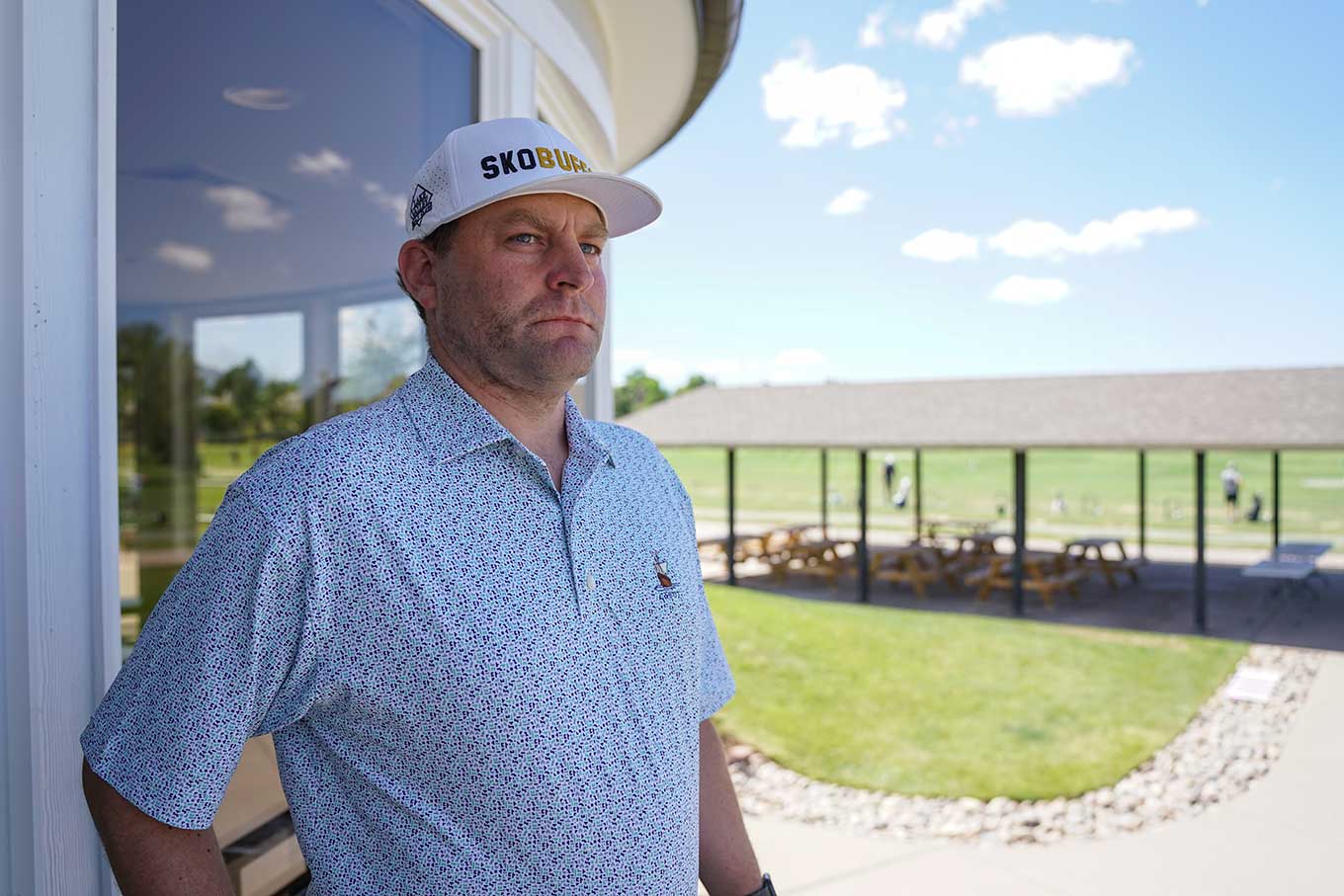
David Myers (right) and his father, Mike Myers (left), enjoy a playful moment on Friday, June 12, 2026, at the Coal Creek Golf Course in Louisville, Colo. The pair was golfing with David’s mom, Sue Myers (far left). Photo by Armando Geneyro/Special to The Colorado Trust
“After working on this for so many years, we are very excited that The Grove is completed and residents can move in,” Sue Myers said in an email. “However, our advocacy is not ending. While the building is built, it is important that the supported services are in place and The Grove becomes truly a community where David and his fellow residents can get to know one another, develop a community relationship and integrate into the larger community.”
About 127,000 people with IDD requested housing services from state agencies in 2022, according to a Colorado Housing and Finance Authority report, but many more remain uncounted. At least 20,000 people with IDD statewide live with aging caregivers, but there aren’t 20,000 units of supportive housing available.
“We are not ready for the tsunami of people that are about to flood the system,” said Desiree Kameka-Galloway, lead consultant of Neuro-Inclusive Housing Solutions, a consulting firm that offers research and guidance on neuroinclusive housing.
For Mike and Sue Myers, learning that David’s application to The Grove had been accepted provided a lifeline for their son’s future. They’ve been working on helping David become more independent. Because David doesn’t drive, he takes the bus or uses Access-a-Ride, RTD’s shared-ride service for people with disabilities. He would make his own breakfast after his parents had already left for the day, and pack a sandwich or salad for lunch.
“We’re really good at breakfast and lunch,” Sue said. “We’re still working on dinners.”
David will continue to master independent living skills, Sue said. And he will have support at The Grove to help prep meals and take care of his apartment.
In Broomfield, there are likely around 2,000 individuals living with IDD—its overall population is about 80,000, and the national percentage of people with IDD is just over 2%. More than 20% of them, including David, live with caregivers who are 60 or older.
People with IDD have historically been institutionalized. That has largely changed, but now, they often face a lack of resources for housing, continuing education and supportive employment. To complicate matters, state and federal funding cuts can limit their choices.
The Grove is among a handful of affordable housing developments dedicated to offering units with services for people with IDD. Those services include things like meal preparation, money management assistance and social activities. Some people with IDD need additional support, like a live-in caregiver who can help with everyday tasks like personal hygiene, cleaning and getting to the store or appointments.
Each development has different offerings. Trailhead Community in Littleton is up and running, and another development, CedarRoot Village in Wheat Ridge, is expected to open in late 2027.
“No communities for this”
David Myers is tall, and on a Wednesday afternoon in late April, his dark brown hair was tucked under a ball cap. He tends to avoid eye contact, which is common in people with ASD, and he answers questions in short statements.
His parents first noticed David might have a disability when he was around 18 months old and hadn’t started walking. His pediatrician told them the best thing for David was to keep him on a similar track to kids his age who were neurotypical.
David was lucky, his parents said. He generally fit in at school and made friends with other kids. In high school, he played football. After high school, he attended Eastern New Mexico University for a year and completed an occupational training program for people with disabilities. The program focuses on independent living as well as job and life skills.
David faced some obstacles while in the program, like keeping track of his phone. Mike would repeatedly drive to the campus in Portales, N.M.—eight hours from Broomfield—to help David locate his cell phone or buy a new one so David could stay in touch with his family.
“That kind of reinforced to us that, OK, we’re going to need some help through the housing part,” Mike said.
When David returned to Colorado, Mike and Sue found Glory Community, a privately owned and operated shared home for people with IDD. David lived there from 2011 to 2017, until financial issues forced Glory Community to close.
His parents thought surely there was somewhere else for David to live. “To our surprise, there were no communities for this,” Mike said.
They got to work advocating for David and other people with IDD. They went to their local elected officials and quickly realized housing for people with IDD was not top of mind.
“At the time, I was 64. Imagine being 64, having no idea where your kid is going to live—knowing you’re just one diagnosis from not being here,” Mike said.
They were among a group of parents who advocated for The Grove when Kristin Hyser, now the executive director of the Broomfield Housing Alliance, came on board in 2022. The planning for The Grove soon got underway.
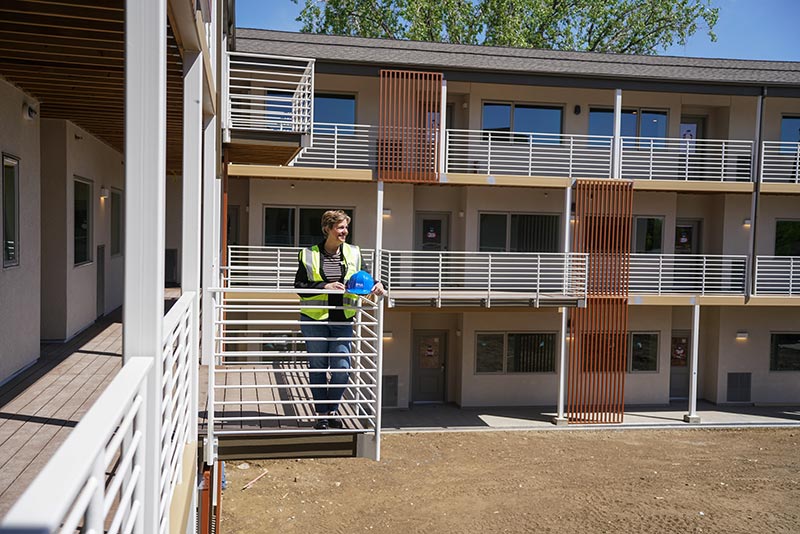
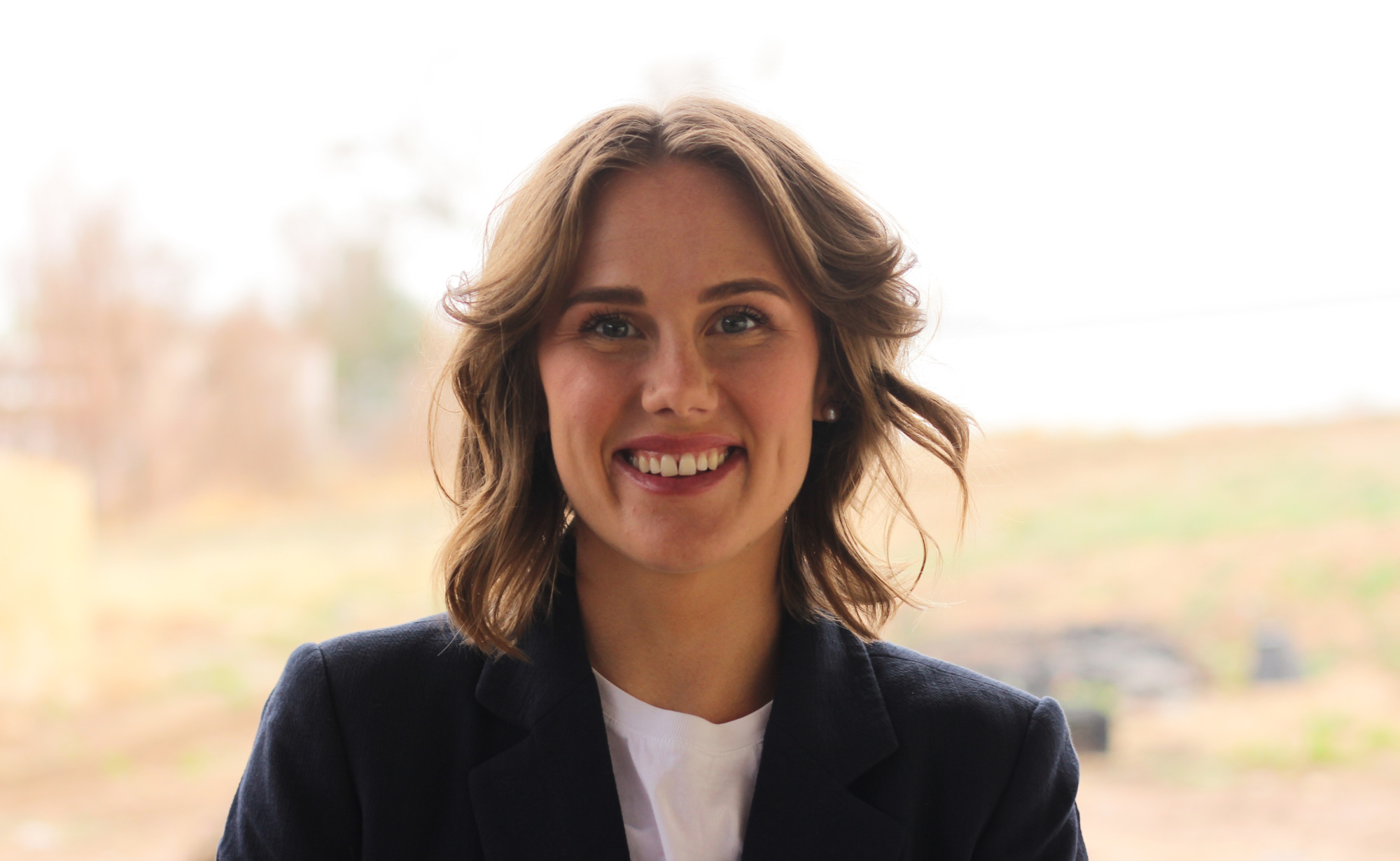
Kristin Hyser, executive director of the Broomfield Housing Alliance, poses in this photograph as she oversees construction work at The Grove at Cottonwood on Friday, May 8, 2026, in Broomfield, Colo. Photo by Armando Geneyro/Special to The Colorado Trust
Like many adults with IDD, David Myers relies on Medicaid waivers to access services. He has long been part of a day program through a local service provider, where he’s gotten connected to social groups and supportive employment services.
He’s fortunate that his parents are not low income and have had the resources to help him, but he will likely outlive their financial resources. And, when they die, he will still need help with tasks like managing his finances, getting around town and navigating the complicated state and federal waiver system.
Waivers are limited by state budgets and restricted to people with certain needs. In Colorado, the waitlist for the Developmental Disabilities Waiver, commonly referred to as the DD waiver, which provides access to 24-hour care for adults with disabilities, is about eight years long (and does not cover housing costs). In 2026, the Colorado legislature faced a budget shortfall of nearly $1.5 billion, largely due to Medicaid costs, which far outpaced the voter-imposed cap on government growth and spending. To make up for the shortfall, the legislature cut back on programs that pay family caregivers and made policy changes to the DD waiver application, which could double the waitlist time.
Some people with significant support needs already don’t receive enough money through the waivers to sustain the care they need, Kameka-Galloway said.
“On the other end, there’s a lot of people with autism, for example, who will not ever qualify for a waiver because they’re not disabled enough,” she said. “They have maybe gone to college, but they can’t hold down a job because they still have executive functioning challenges.”
They need supportive housing, but they can’t access the waivers, and they don’t make enough money to afford even an affordable housing unit. “We find that those are the individuals that are at highest risk of homelessness,” Kameka-Galloway said, “because they’re not getting the support they need to live independently.”

Christopher Steinhoff of Main Street Movers walks up the ramp of a moving truck to finish moving the last of Gabrielle Gonzales’ belongings on Saturday, Aug. 15, 2026, at The Grove at Cottonwood in Broomfield, Colo. Photo by Armando Geneyro/Special to The Colorado Trust
In Elbert County, Tracy, who asked that her last name be omitted from this story to protect her sons’ privacy, has two sons with autism and no options for housing them outside of her home.
“I’ve got two 18-year-olds who have one year left of school because we held them back because of their disabilities, and they’re going to be in my house,” she said. “We’re stuck on top of each other.”
Her children do not qualify for waivers, she said, and there aren’t any housing developments with services for people with IDD in the small community where they live. Tracy enrolled the boys in multiple types of therapy to address their needs. She’s moved them to different schools and structured her family’s life around caring for them, but now they face a hurdle she’s not sure they can overcome.
“We have tried a hundred different things to try to figure out how to help them live the [most] close-to-normal life as possible,” she said. “But we’re at this stage right now where we can’t really house them into adulthood because our house is so small.”
A few years ago, Tracy’s husband was diagnosed with skin cancer. The financial burden from the cancer treatment forced them to move into a smaller home. He’s now in remission, and they both have steady jobs.
“I guess our goal is to climb out of the cancer debt hole that we were in from a couple years ago,” Tracy said. “Hopefully, we’ll be able to get a loan and be able to get a piece of property that we could have them build a tiny house on.”
She’s hopeful they will find a solution, but budget cuts to state and federal programs worry her. She also has two other children, ages 4 and 16.
David Myers’s parents added him to the DD waiver waitlist when he was 13 years old and waited nearly a decade before he received it.
The waiver will help David afford the services he needs at The Grove. But despite his family’s involvement in getting The Grove built and his demonstrated need, he wasn’t guaranteed a spot because of fair housing laws. Instead, David got on a waitlist with about 200 other people. He found out in July that he would be moving into the development.
“If something were to happen in the middle of the night, he could call them,” said Sue Myers. “He’d also probably call us, but we’re talking about down the line, he’ll always have someone that he can reach out to.”
Meeting the diverse needs of residents
The multi-building Grove at Cottonwood is located next to the Bal Swan Children’s Center, an inclusive early education center. It includes a U-shaped, three-story traditional apartment building attached to a community space, which will house a small game room and library, a communal kitchen and a resident services concierge.
“We were very intentional. We could have come in and just built one huge mega building, except that we really wanted to honor the building typology of the neighborhood,” Broomfield Housing Alliance’s Hyser said. “Also, we wanted to make sure that all the units were facing each other and so that it’s kind of like eyes on the community at all times.”
The apartment units at The Grove are spread across three buildings, and the development is a project of the Broomfield Housing Alliance. Of the 40 units, 10 will be supported by the Section 811 Supportive Housing for Persons with Disabilities program, which subsidizes housing for extremely low-income adults with significant, long-term disabilities. These project-based subsidies, which the federal government provides, are limited in number. In Colorado, as of 2022, 549 vouchers had been allocated, according to the CHFA report.
People with IDD can apply to live in any of the units, but so can people without IDD who meet the income limits. There are no state or federal housing programs tailored to people with IDD. That means housing developments like The Grove can have services specifically for this population, but they can’t require that tenants have IDD, unless they are applying for a unit with a Section 811 designation.
People with IDD are almost always financially eligible for housing assistance. Still, there’s already a shortage of more than 110,000 affordable rental units for low-income households in Colorado, according to the National Low Income Housing Coalition.
Rent in one of the Section 811 units at The Grove will be $810 for a one-bedroom apartment. The other 30 units are capped at 60% of the area median income, which is about $60,000 annually for a one-person household. A one-bedroom for someone with this income will be $1,620 per month.
People with IDD often face discrimination in housing from landlords or neighbors. In 2023, more than 34,000 people reported housing discrimination complaints, according to the National Fair Housing Alliance.
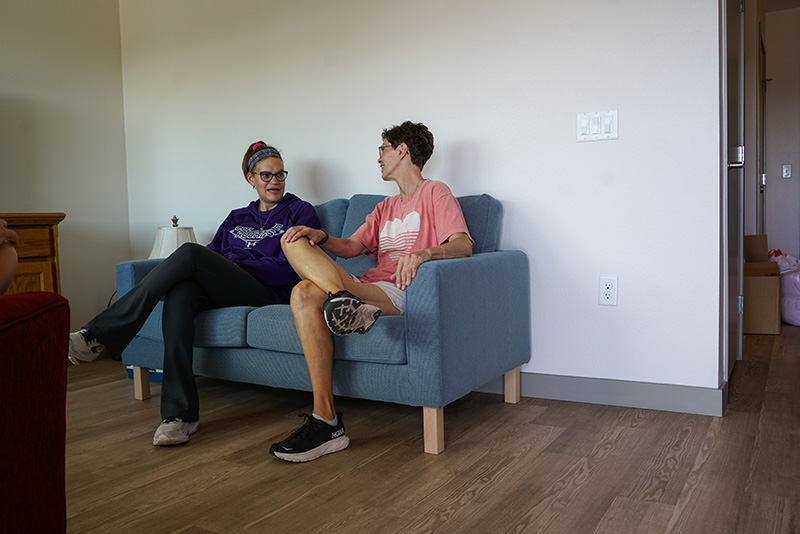
Gabrielle Gonzales (left) and her mother Kori Gonzales (right) sit inside the living room of Gabrielle’s new apartment on Saturday, Aug. 15, 2026, at The Grove at Cottonwood in Broomfield, Colo. Photo by Armando Geneyro/Special to The Colorado Trust
Safety is a top consideration for many people with IDD who want to live at The Grove, including 32-year-old Gabrielle Gonzales. She was diagnosed with pervasive developmental disorder as a toddler; it’s now under the autism spectrum disorder umbrella, although she has never received an autism diagnosis.
“For me, it was just a safer community,” said Gonzales, who goes by Gabs. “It would be just more people on site who would look out for all of us. Just with having Medicaid and low income and stuff. It just sounds a lot safer.”
Before moving into The Grove, Gonzales lived with her parents, Kori, 62, and Tracy Gonzales, 63, in Westminster. Her parents are excited about the on-site services offered at The Grove. In the past, Gabs lived in an affordable housing apartment, but it was not tailored to people with IDD.
“There were a couple of people who took her under their wing, but we were still very involved because there weren’t wraparound support services,” said Kori, Gabrielle’s mom. “As we get older, there’s going to be a transition where we’re not going to be here to help Gabs anymore, and she’s going to need to feel comfortable with other people.”
The Grove was designed to suit many of the needs of people with IDD, even though not all the units may be occupied by people with IDD. The units are all accessible for people in wheelchairs or who use walkers or canes. The needs of people with IDD go beyond the physical buildings, which is why the Broomfield Housing Alliance is hiring a resident services concierge.
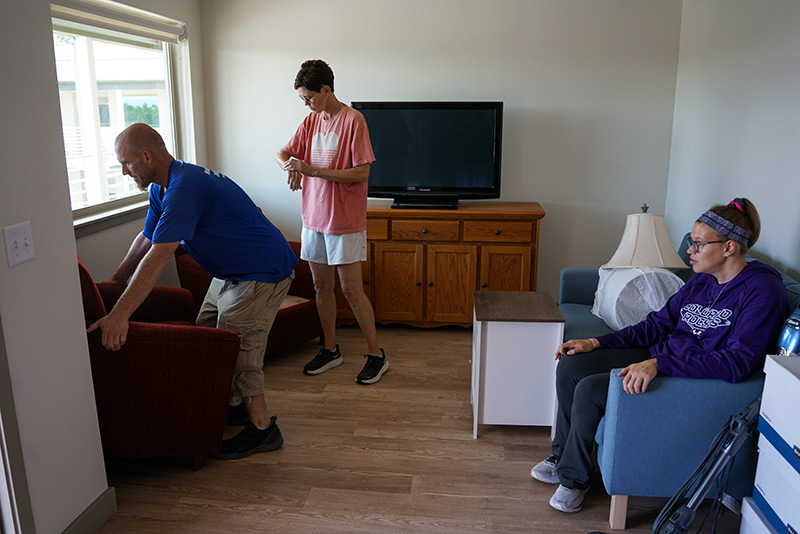
Christopher Steinhoff (left) from Main Street Movers helps move Gabrielle Gonzales’s living room furniture into her new apartment while her mother Kori Gonzales supervises on Saturday, Aug. 15, 2026, at The Grove at Cottonwood in Broomfield, Colo. Photo by Armando Geneyro/Special to The Colorado Trust
When Hyser and her team started planning The Grove, they hosted focus groups with local service providers and people with IDD to ask what services they wanted to see. It became clear there was no one-size-fits-all design the team could deploy—for example, some interviewees favored bright colors and natural light, others the exact opposite.
Hyser said she and her team tried to design The Grove in the same spirit of permanent supportive housing—a model aimed at helping people experiencing chronic homelessness transition into housing.
Providing support services on site
Part of the support at The Grove will come from outside community service providers, such as FRIENDS of Broomfield, the only Broomfield-based, state-certified nonprofit organization supporting teens and adults with developmental disabilities. Residents with IDD will also rely on their family support systems, friends, neighbors and the supportive services at the housing complex.
“It’s going to take the community, and it’s going to need to be very intentional for those who have more limited resources,” said Gina Coufal, CEO and founder of FRIENDS of Broomfield.
More than 20 years ago, Coufal, who has a son with a rare chromosome disorder, autism and cerebral palsy, and a group of parents with children with IDD got together to start to plan for their children’s lives after high school.
FRIENDS became an official service provider with a day program in 2005. When Coufal’s son left school, he entered the day program. Today, he lives with his parents.
“He is one of those individuals who has profound needs that we need to shift our focus to in the future,” Coufal said.
In anticipation of The Grove’s opening, FRIENDS provided training, including training for the Myers and Gonzales families, in which parents and their adult children with IDD learned about the transition from living together to living apart.
“We’re trying to do as much prep work as we can with the families through the [Independent Living Academy] and through the Helicopters to Empty Nesters groups,” Coufal said. “And while we’ve done a lot to get them financially prepared—giving them information, resources to get these things done—we’re now focusing on the emotional side of it because, ultimately, that’s what could make or break a decision.”
It’s one thing for parents to know that their adult children are financially supported and another to worry about what it will be like to live apart. Many families, including the Myers and Gonzales families, have lived with their adult children with IDD for most of the last 30-plus years.
Gabs Gonzales and her family said they enjoyed the classes.
On move-in day on Aug. 15, Gabs and her mom were overwhelmed with excitement and nerves. After years of advocating, Gabs finally has a place to live on her own.
“We were told a long, long time ago that Gabs would be with us forever because there wasn’t going to be anything else available,” Kori said. “And that didn’t happen.”
On the kitchen counter, Hyser left a framed photograph of herself alongside the Gonzales and Myers families and others, all in hard hats with shovels at the site of The Grove.
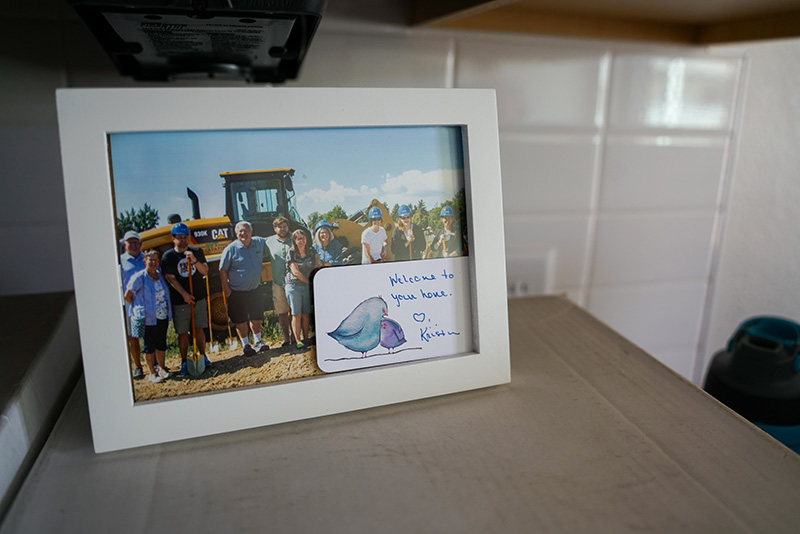
A framed photograph with a note welcoming her to her new home sits atop a box of Gabrielle Gonzales’ belongings on Saturday, Aug. 15, 2026 in her new apartment at The Grove at Cottonwood in Broomfield, Colo. Photo by Armando Geneyro/Special to The Colorado Trust
Gabs said she is most looking forward to “being here with all my friends.” Some of the other families who participated in the Independent Living Academy are also moving into The Grove.
Editor’s Note: Claire Cleveland, the author of this story, is employed with Creative Circle, an agency that produces “The Buildout,” a podcast on affordable housing, which is funded and published by the Colorado Housing and Finance Authority.