Marissa Garcia can barely finish a sentence before a student stops to chat with her. She’s sitting in the blue-walled wellness room in the high school wing of York International School in Thornton. The calmly lit space is decked out with pillows, fidget spinners, games and a small hygiene closet. A steady stream of backpack-laden students walks past the open room between class bells. Garcia, who has curly black hair and is wearing gold-hoop earrings, a nose ring and a hoodie, looks a lot like them.
The 24-year-old is part of the inaugural Youth Mental Health Corps (YMHC), a national service initiative that places near-peer mental health navigators in middle and high schools to help support students and develop the next generation of behavioral health professionals. Colorado was one of four states to pilot the program in fall 2024. One hundred and forty-four corps members were deployed to more than 60 schools, after-school programs and a community health center across the state. The corps wrapped up its second year, having expanded to 11 states, with another five set to begin in the fall and an additional 11 in the planning stages for 2027.
Data collected after the first full year show that the effort is simultaneously improving student attendance and behavioral health while helping to grow the overstrained mental health field by making it easier for young adults like Garcia to access training and start their careers.
Garcia works full time at York International School as an engagement support member. She is not a licensed therapist or counselor, but she’s trained to identify mental health problems among students and provide connections and support. She regularly meets with a caseload of 27 high school students who struggle with attendance and school engagement. She’s constantly receiving referrals from teachers or connecting with students who ask for a few minutes of her time. Garcia helps them access resources, such as clinical mental health support or reliable transportation to and from school, and she works with them on social-emotional skills and goal setting. Often, her role is simply to listen to what’s going on in the students’ lives.
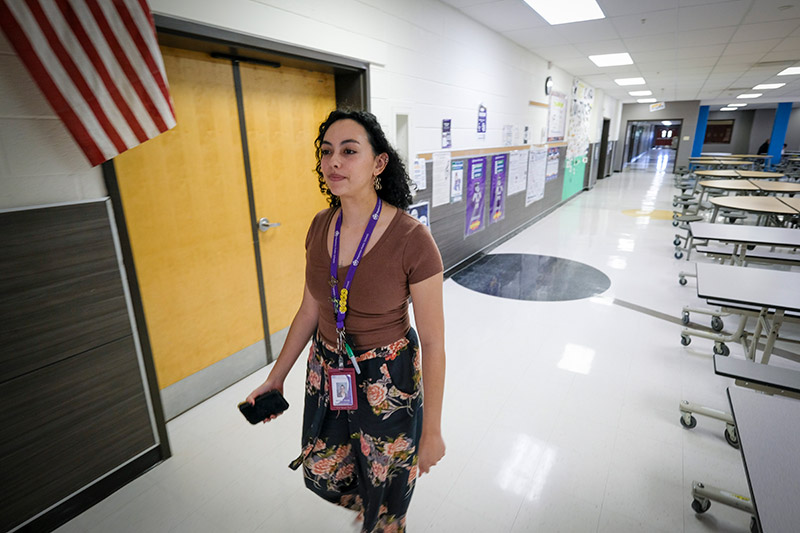
Marissa Garcia, a Colorado Youth Mental Health Corps member, walks to the main office at York International School after meeting with a student on Tuesday, April 21, 2026, in Thornton, Colo. Colorado was one of just four states to be part of the inaugural year of the program, which expanded to 11 states for the 2025-26 school year. Photo by Joe Mahoney/Special to The Colorado Trust
“Marissa, because of her young age, can really connect with students in ways that I can’t as a 47-year-old,” said Ben Schneider, assistant principal at the school. “She has the ability to connect with them and develop relationships and be really in their corner in a really significant way.”
Youth mental health is considered a global crisis. Forty percent of high school students in the U.S. report feeling sad or hopeless, according to the Centers for Disease Control and Prevention, and suicide is the second-leading cause of death for people ages 10 to 34.
“I struggled with mental health in high school,” Garcia said. “I’m still young. I even think it’s scary talking to adults sometimes, so I get relying on someone who is more your age because they can relate more.”
“We are really building out this community of care where peer support is as valued as clinicians and … really growing access to mental health resources at all levels, not just when we’re talking about clinical interventions,” said Fiona Yung, a program officer at the Seattle-based Schultz Family Foundation, which provides national YMHC funding.
YMHC is part of AmeriCorps, a federally managed national service organization. Most states run their own AmeriCorps commissions that set regional priorities and distribute grant funding. Serve Colorado is the Centennial State’s commission. Colorado YMHC is supported by five program partners, including Colorado Youth for a Change, an education-focused nonprofit and Garcia’s connection to the work. (Garcia began working at York International School through the nonprofit’s Corps for a Change program the year before YMHC’s launch.)
But the new corps isn’t just focused on serving students—it also aims to increase the number of available mental health providers and diversify the field. Garcia and other members, who receive stipends for their service, have access to free trainings before their first day, such as Mental Health First Aid, and cultural competency; ongoing professional development, including monthly AmeriCorps networking sessions; career coaching; and, in Colorado, college credit hours or enrollment in a behavioral health assistant credentialing program through the Colorado Community College System.
In 2025, Colorado unveiled a new behavioral health credential pathway in response to a severe provider shortage. It makes it easier to develop entry-level behavioral health practitioners by helping people build their knowledge through flexible learning modules that allow them to join care teams and provide services as they learn. Those so-called microcredentials can then be stacked together and put toward a higher qualification, such as an academic degree.
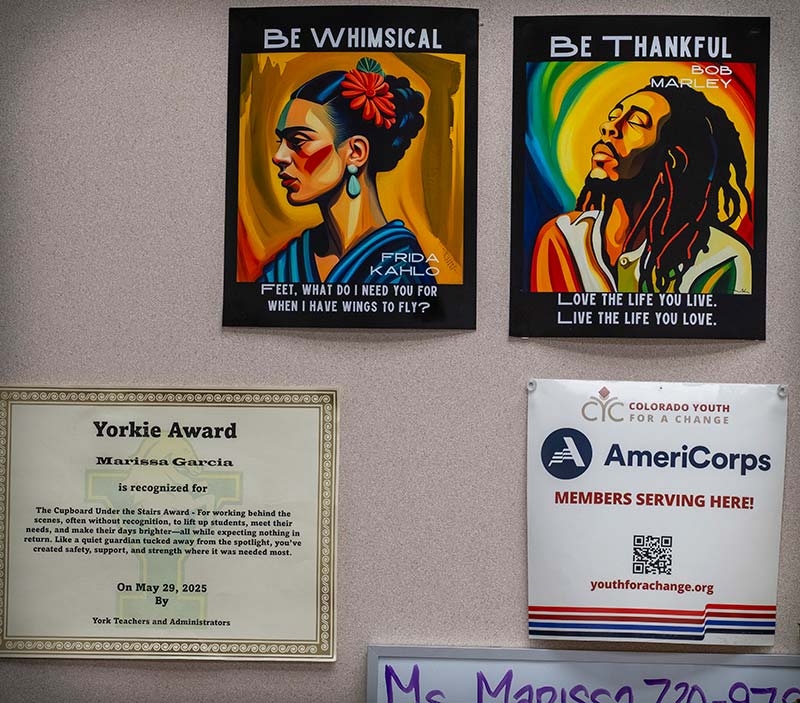
Posters and an award hang on Marissa Garcia’s wall in her office, as seen in this photo from Tuesday, April 21, 2026, at York International School in Thornton, Colo. Garcia is a Youth Mental Health Corps member, working to help students navigate mental health challenges and other areas where they may need support. Photo by Joe Mahoney/Special to The Colorado Trust
Between 2019 and 2022, the Colorado Department of Labor and Employment reported a 152% rise in behavioral health job openings. The Colorado Behavioral Health Administration projected a shortage of 4,400 mental health workers in the state by this year. Most of Colorado is considered a mental health professional shortage area, meaning there aren’t an adequate number of providers to serve the population.
In the program’s first year, 104 Colorado YMHC members completed their service term, earning 87 behavioral health associate certifications and six Master of Social Work degrees. YMHC connected with more than 7,100 students during that period, and corps members have received $600,000 in funding to use toward their student loans or further education, according to Serve Colorado.
“We’ve designed the Youth Mental Health Corps to really focus on recruiting young people that are from these communities,” Yung said. The goal: They work in their local neighborhoods and continue serving those areas after their corps service terms end.
Garcia is from Northglenn and graduated from Adams 12 Five Star Schools, a neighboring district to York International’s Mapleton Public Schools. At the end of the 2025-26 school year, she aged out of the corps program, which employs 18- to 24-year-olds and is capped at four terms of service. She’s already earned a bachelor’s degree in Family and Human Development from Arizona State University. In the fall, she’ll start her master’s degree in social work at Metropolitan State University in Denver.
Nationally, YMHC programs have seen improvements in student attendance and a decrease in behavioral referrals, and 20% of corps members found employment before their service year ended, according to a report on first-year outcomes. Serve Colorado found that 65% of youth accessing YMHC programming “have shown increases in their social emotional learning skills or an increase in school engagement,” which includes attendance, behavior and academics.
“What’s so exciting about launching the Youth Mental Health Corps is that it was so innovative. It was a way to get more mental health workers on the ground,” said Colorado Lt. Gov. Dianne Primavera, whose office oversees the local initiative. “To have this model where it’s peer-to-peer or near-peer help, I think, is really, really powerful.”
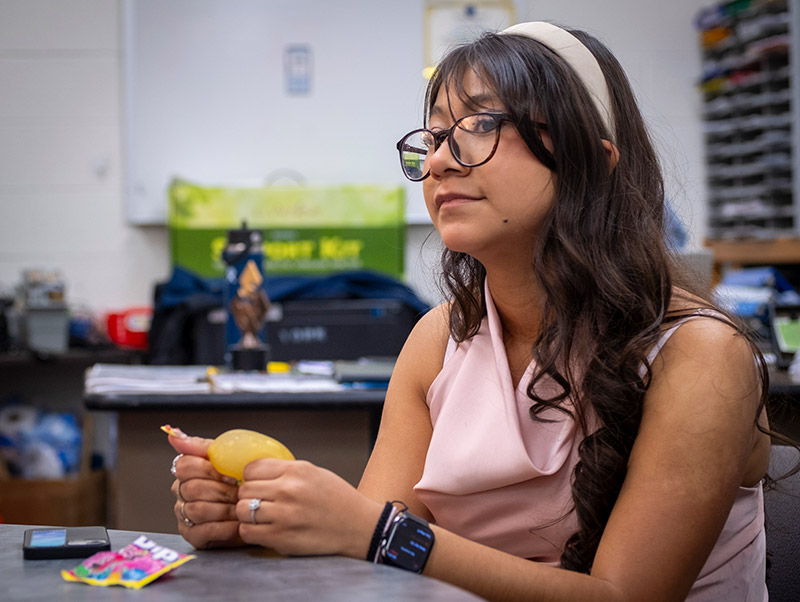
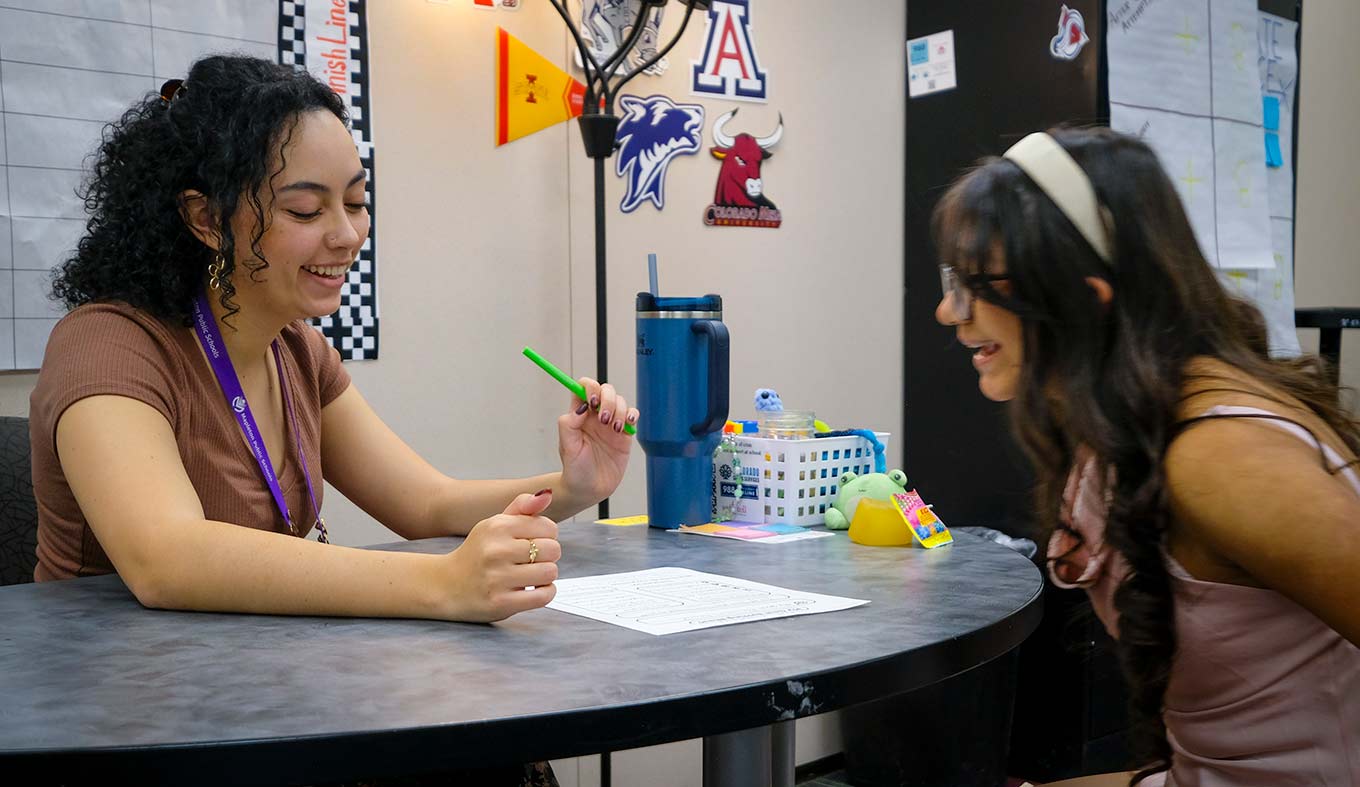
York International School student Leah Ameca, 17, squeezes a stress ball while meeting with Marissa Garcia, a Colorado Youth Mental Health Corps member, on Tuesday, April 21, 2026, in Thornton, Colo. Garcia is part of the national program that places near-peer mental health navigators in middle and high schools. Photo by Joe Mahoney/Special to The Colorado Trust
Leah Ameca has benefited from that near-peer connection. Garcia initially met with the 17-year-old because of Ameca’s poor attendance and slipping grades as a freshman. Ameca has attended York International since kindergarten and is now entering her senior year.
Ameca struggles with depression and anxiety and said she found it hard to get to school on time for her 6 a.m. orchestra class because she was tired or just didn’t feel like it. She worked with Garcia—meeting at least weekly—on time management and on building healthy habits, such as eating more nutritious food and drinking water. Ameca said she used to self-harm but doesn’t anymore. She is now in therapy and taking medication.
Garcia encouraged Ameca to ask for help and sat with her during the first semester of sophomore year when she told her parents about what was going on with her mental health. Garcia supported Ameca as she worked to find a therapist with whom she felt comfortable.
“At the time, I didn’t like talking about my feelings with my family. I didn’t like talking about my feelings with anyone,” Ameca said. “I liked being independent about that. But I’m very happy that I didn’t stay quiet, that one day [when I disclosed my cutting], because that one day changed my life. And if it wasn’t for that one day, I don’t think I would be here.”
Ameca’s grades and attendance have improved. She made the honor roll the second semester of her sophomore year. She calls Garcia a “friend with boundaries” and finds it easier to communicate with her than with a therapist or social worker. She feels a sense of responsibility to get to class or complete her work because she knows Garcia will check in about them.
“I didn’t really have a leader or an adult that I trusted, really,” Ameca said. “I clicked a lot with Marissa. … I’m very grateful for that.”
Schneider, the assistant principal, calls Garcia a first responder who “can act as a filter [who] either redirects students back into class with some quick supports or redirects them to deeper mental health supports.”
York International School is unique in its mental well-being offerings. Not only does it have a YMHC member, but the school district also employs a social worker, therapist and case managers.
“[We’re] working really hard to move past a simple disciplinary model where we punish kids for misbehaving in class and instead move into places where we’re trying to address the root of their behavior and support them, instead of punishing them for having a hard time,” Schneider said.
School staff receive training and follow a protocol for identifying and helping students who are experiencing a crisis or need extra support. Students can be sent to the wellness space to touch base with Garcia or another mental health provider or staffer if they’re having a tough time in class, or, more often, they seek out the calm environment on their own. Garcia typically starts her morning in the room and will sometimes spend her entire day engaging in spontaneous conversations.
“Young people want to open up to someone who’s their peer, communicating in language they understand. The social norms are the same. All those pieces are so simple and also can’t be understated,” said Mary Zanotti, executive director of Colorado Youth for a Change, one of the five organizations involved with the YMHC in Colorado. “When they see someone from the same culture and background advocating for [mental health], it makes a big difference.”
A recent “Developmental Assets Profile” survey of 775 students, which Colorado Youth for a Change compiled, showed that 91% of respondents served by Youth Mental Health Corps members reported improved school engagement and a positive sense of identity.
While chronic absenteeism remains a problem at York International School and across Colorado schools, the Thornton institution’s 25.8% rate is below the district and state averages (35.6% and 28.4%, respectively). Schneider says Garcia’s role has put a dent in that issue and has had a positive effect at the school.
“I think our students are safer because Marissa is here,” Schneider said. “We see students … coming here to seek support, whereas before, there wasn’t anywhere to go. There’s no data on how many crises we’ve averted or how many suicides we’ve averted. But I’d like to think there’s some that we’ve headed off.”
“It’s not a role that we’d be able to fill ourselves,” Schneider added.
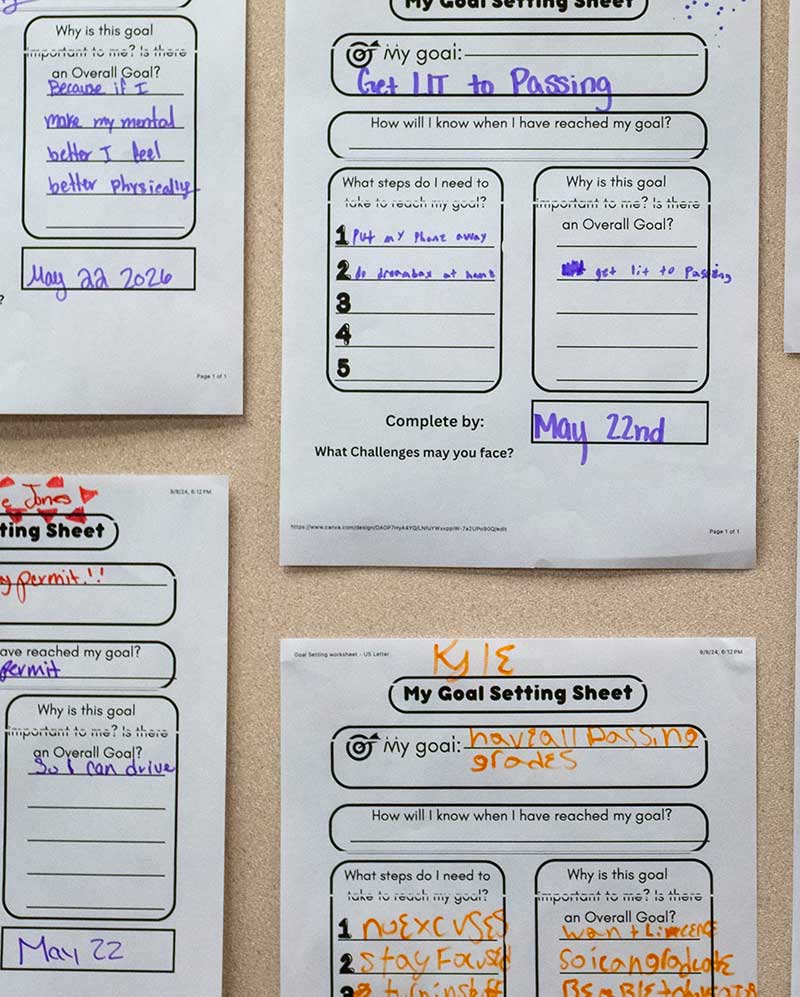
A series of sheets with students’ goals on a corkboard are displayed above Marissa Garcia’s desk on Tuesday, April 21, 2026, at York International School in Thornton, Colo. Garcia is a Colorado Youth Mental Health Corps member who has had a positive effect on students and the school, said Assistant Principal Ben Schneider. Photo by Joe Mahoney/Special to The Colorado Trust
AmeriCorps, the Schultz Family Foundation and Pinterest fund the national effort, with support from individuals and philanthropic groups. Colorado’s program also receives state-based aid and other grants. Schools pay a host fee if they’re able. According to Zanotti, it costs approximately $38,000 per AmeriCorps tutor, with the federal funding covering less than half. In Colorado, members like Garcia make just over $25,000 for their 1,200-hour service term.
“We’re really happy with the success of the program,” Primavera said. “I think there’s a possibility that it’ll lower long-term spending in juvenile justice and child welfare and Medicaid and things like that.”
In April 2025, the Trump administration stopped close to $400 million in grants to AmeriCorps, though that decision was later overturned in court following a lawsuit brought by Colorado and other states. The Colorado General Assembly partially funded Gov. Jared Polis’ budget request for YMHC funding at $750,000, ensuring that YMHC will continue in the fall.
Throughout the final months of the school year, Garcia was available to students every day. She often notices signs of depression, hopelessness and lack of motivation among students, she said. They talk about relationships, and the toxicity of social media. Many want support but aren’t sure where to find it.
“Mental health can be a hard topic, especially with the population here at York. A lot of them are very cultural, and so we have different views of mental health,” she said. (The school population is majority Hispanic/Latino and economically disadvantaged.) “I think my job is to just continue to educate the students about facts on mental health and what is real and validate their feelings.”
It’s a narrative she’s familiar with, having grown up in a Hispanic family that, she said, “tiptoed around the subject” of mental health. She blames a lack of information and education—both of which she is trying to counter with her career choice. Garcia’s increased knowledge has helped improve her own family dynamic.
“I’ve had some pretty dark times, especially through high school. I understand firsthand how it feels to not want to wake up the next morning,” Garcia said. “That’s something I really push for with the kids I work with—helping them understand that this is just one little piece of your life. High school is not how the rest of your life is going to look. There’s so much more out there.”