For years, the money on Jessie Dorris’ electronic benefits transfer, or EBT, card was enough to buy groceries for herself and her son. As a single mom who was working to improve their lives, she carefully maintained a tight budget every month.
But grocery costs kept going up, and despite Dorris remaining frugal with her spending, the money wasn’t stretching as far.
“I don’t buy fancy stuff. … It kind of snuck up on me,” the 42-year-old Denver resident said.
Recent health issues that forced her to take time away from graduate school and work exacerbated the situation. So, when Dorris learned that the nonprofit Colorado Food Cluster was starting a no-cost grocery pilot program last summer, she applied and got accepted.
Colorado Food Cluster (a Colorado Trust grantee) focuses on reimagining food systems to increase access to nutritious foods and healthy outcomes. It launched the yearlong Food Trust pilot program in July 2025 in partnership with Morgridge Family Foundation, NewImpact and Metro Caring, raising more than $2.1 million from philanthropy (58%), public sources (41%, including congressionally directed spending) and the private sector (1%). Now that the pilot program is nearing its end, nonprofit leaders are analyzing a trove of data and planning next steps.
Officials designed the Food Trust as a universal basic food program, meaning any resident could qualify for access to healthy, high-quality food, regardless of income, age or background. Participants were limited to those who live in specific zip codes near the two grocery stores operating the program: Save A Lot at 7150 Leetsdale Drive in Denver and Simple Foods at 680 Grand Ave. in Del Norte, in the San Luis Valley. (The zip codes used for the Del Norte location extended farther out than those around the Denver store.)
“Our hope is that every neighborhood has a program like this in their neighborhood stores,” Food Cluster Executive Director Kristen Collins said. “And I think the bigger pie-in-the-sky dream is that we’re incentivizing healthier food consumption choices.”
The program differs from other nonprofit food assistance models, such as meal deliveries or food pantries, in that participants shop for food in grocery stores, giving them access even at times when other options may be unavailable or closed, and in stores outside the charitable-giving space. Participants use software similar to a store loyalty system, logging in with their phone numbers, rather than using cards or paper vouchers.
Additionally, the amount of monetary credit participants receive on their accounts ($11.23 per day) is the same for each person in the household—it doesn’t change throughout the program and doesn’t taper off based on the number of people in a household, unlike with federal benefits programs. The credit is limited to specific items selected by the grocery stores in partnership with the Food Cluster, including fresh fruits, vegetables, meat and dairy.
“We really have been successful in building something that’s pretty unique,” said Jack Becker, principal strategy advisor for Colorado Food Cluster. The goal, he said, was to find a way to provide “healthy food in a dignified, friction-free, low-cost way,” working directly with grocery stores.
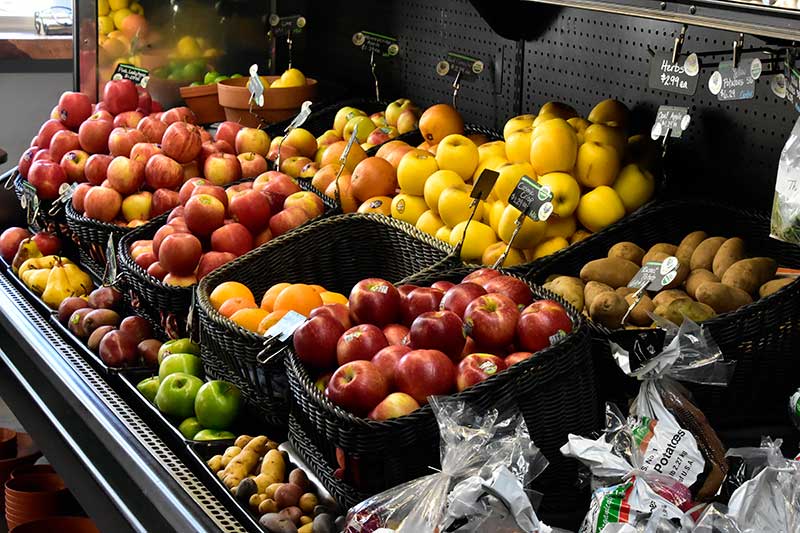
Fruit in the produce section at Simple Foods Market on Friday, Dec. 19, 2025, in Del Norte, Colo., is shown in the photo above. Many of the items are labeled with “Food Trust” stickers. Photo by John McEvoy/Special to The Colorado Trust
More than 850 people applied for 150 spots in the Food Trust program (181 people from 72 households ultimately participated by the end of the pilot). The project implemented aspects of the Community Food Utility model, which advocates for treating high-quality, healthy food as a public utility (and access to food as a human right), and considers hunger a market failure. Metro Caring, a Colorado anti-hunger organization (and Colorado Trust grantee), conducted research with Seattle-based nonprofit New Impact to identify potential program areas for a Community Food Utility in Denver, including a universal basic food program.
The Food Trust pilot program was designed not only to assist low-income households that could be eligible for federal benefits but also to support other low-income or middle-income families struggling to make ends meet. More than 50% of the pilot program’s participants were not enrolled in Supplemental Nutrition Assistance Program (SNAP), Women, Infants and Children (WIC), Medicaid or Medicare. About 87% of households in the program made less than $50,000 per year. (Nearly half of Colorado families facing food insecurity don’t qualify for SNAP, according to 2025 data from the Colorado Health Institute, with thousands more losing benefits this year because of new federal eligibility requirements.)
The populations living near both of the stores are predominantly white, followed by Hispanic. The Hispanic or Latino/a/x participants are overrepresented in the Denver store (37% of those enrolled, compared with 18% living in the area) and underrepresented in the Del Norte store (35% enrolled, compared with 42% in the area), according to a Colorado Food Cluster report.
The nonprofit analyzed Food Bank of the Rockies data to identify core common food items across cultures and backgrounds, so the pilot program could initially cover at least 100 items. The list has since grown and evolved after staff reviewed purchase data—something typically available only to third-party companies that create software for grocery store loyalty programs—and worked with a registered dietitian and the store owners. They also used U.S. Department of Agriculture parameters, consumer price index targets and other formulas to estimate daily costs.
For Dorris, those extra funds have made a huge difference in everyday life.
“It just took such a mental load off of me… because what’s our biggest stress? Really, most of the time, it’s finances,” she said. “So just being able to keep my limited cash for what I need to pay, thanks to Food Trust, was everything. … We were able to get my son a nice birthday cake for his birthday in December because money wasn’t so tight.”
Colorado Food Cluster leaders are assessing how they can leverage public, private and philanthropic partnerships to create similar, more permanent projects in the future that can serve as a model for other communities.
The program tested many factors around food habits, Collins noted. Would people switch from shopping at the closest big-box grocery store to shop at the specific ones that implemented the food program? What are the true costs of buying healthy, raw ingredients to make meals at home? What are some of the other items people are buying that aren’t covered by the pilot program? What kind of impacts would this program have on participants’ mental health, their housing and the health care system? How does this affect local growers and producers?
As part of the program, Food Trust participants complete quarterly surveys to provide feedback and information about the program’s effects on various aspects of their lives. Some of this data and analysis will be publicly available in a preliminary report in September, with a final report expected by the end of the year.
The Colorado Food Cluster wants to find ways to use existing systems so that programs like the Food Trust can be effective yet cost less than federal safety-net programs and achieve greater financial stability. With the Food Trust, the relationship with grocery stores was paramount, Becker said. In addition to giving consumers choices while shopping and helping destigmatize the experience of shopping with food assistance, “they have the amazing logistics, infrastructure; they have the supplier relationships,” and people want “one-stop shopping.” That makes it easier and less costly than starting from scratch.
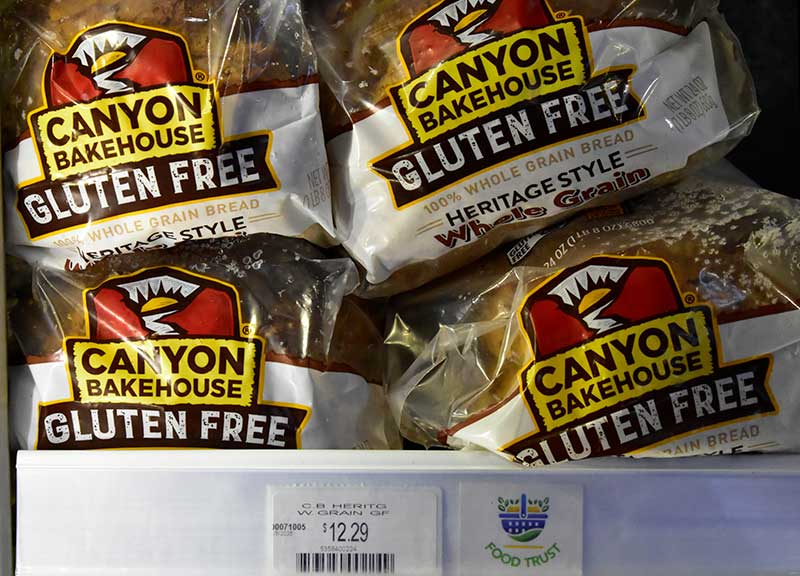
Simple Foods Market in Del Norte, Colo., is one of two grocery stores in the Colorado Food Cluster’s Food Trust pilot program. Fresh and frozen food options, such as the bread pictured above on Friday, Dec. 19, 2025, are included as covered items in the no-cost grocery program. Photo by John McEvoy/Special to The Colorado Trust
Leevers Supermarkets, Inc., based in Castle Rock, operates many of the Save A Lot stores in Colorado, including the Leetsdale location in Denver. Chief Operating Officer Jon Koontz said the independent operator prides itself on catering to the needs and desires of the people who live around its stores, noting that the store on Leetsdale serves people from a variety of different ethnicities and backgrounds.
“If we have a certain sub-demographic, we can work with our suppliers to find product lines and bring them into the stores to make sure that they’re getting access to the food that means the most to them, whether that’s cultural, economical, whatever the case may be,” Koontz added.
“And so, the CFC’s mission to bring affordable food that fits from a nutritional standpoint… it really is just another way of making sure that people have access to what they need.”
Koontz said the store has attracted new customers it wouldn’t have otherwise with the program, which gives the owners confidence they could expand it to future stores.
According to an unpublished Food Trust report, the program has generated over $250,000 in grocery store revenue, including 25% from customers paying for items not covered by the program, and saved customers $211,000 in grocery costs. Items the program covers can be found on the website portal, on signs at the stores or on labels on the items themselves.
Ian Walker, the owner of Simple Foods Market in Del Norte, bought the store in April 2024, and just a few months after that, he jumped at the chance to participate in the Food Trust program. Walker said he also immediately began to see people shopping at his store that he’d never seen there before, accessing local meat, produce, eggs, bread and flowers.
“It gives me an opportunity to start a relationship and be the sort of small-town grocer who, rather than being perceived as an expensive natural food store, [offers] different options, especially with Food Cluster, that help make everything more affordable,” he said.
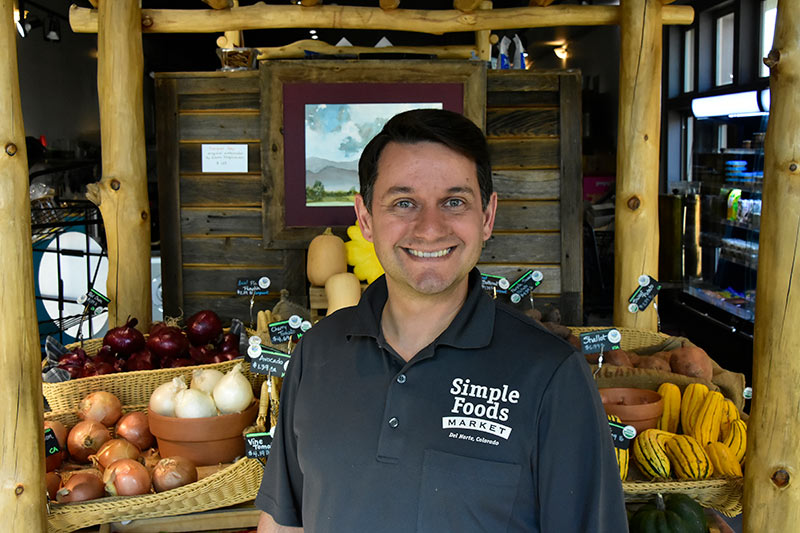
Simple Foods Market Owner Ian Walker poses in front of a fresh produce display on Thursday, Dec. 18, 2025, in Del Norte, Colo. Photo by John McEvoy/Special to The Colorado Trust
In a town with a federal poverty rate of 18.5% in 2024, significantly higher than the state’s at 9.6%, and with a household median income of $40,700, compared to Colorado’s median income of $95,470, Walker said he appreciates the opportunity to serve his neighbors. The program helps fill the gaps for people who may not technically qualify for federal assistance programs but are still food insecure, he said, and it allows them to make healthy meals at home while funneling money back into the community through local food purchases.
Plus, the program added a benefit Walker hadn’t foreseen: The store was down 50%-75% in food waste from spoilage, particularly in the produce department, in the first few months of the pilot.
The notion of buying healthy food in a dignified way came into sharp focus for Dorris last November when the federal government shutdown froze SNAP benefits.
“Oh my God, I was so grateful [for the Food Trust],” Dorris said. “None of us got food stamps in November, and all of my neighbors were struggling.”
Dorris considers herself lucky—she had enough credits in her Food Trust balance to get her through. Because she didn’t use her allotment when she was sick for a month and her mom had bought her groceries, she was able to spend it on herself and her son and buy food for her neighbors in their affordable housing complex.
One of the biggest highlights of the program, Collins said, is the ability to react and adapt to changes in real time. The Colorado Food Cluster issued a callout to people enrolled in SNAP or WIC who were not receiving benefits and to government workers who were working and not receiving pay or were furloughed due to the shutdown. Fifty-seven people from 10 households were temporarily enrolled in the Food Trust, enabling them to get no-cost food at grocery stores the same day they received approval. Participants already in the program who had unused balances were able to donate some of their funds to help those affected by the shutdown, contributing about $14,000.
Becker jokes that the pilot program made “Colorado Food Cluster an accidental tech company,” because rather than spending significant money on a new third-party system, the program built a solution that layered on existing technology and infrastructure, which was effective and lower-cost, and made changes like this possible. That doesn’t mean participants never ran into any technical difficulties with their balances or in figuring out which products are covered and which aren’t, but the program and stores have helped participants navigate these issues.
Susan Graham, a Del Norte resident, signed up for the Food Trust after learning about it from a coworker. Graham, a 62-year-old clinical social worker, said in December that she was almost embarrassed to participate at first because she wasn’t at risk of food scarcity. But she was excited to share feedback about her experience, and the no-cost program has allowed her to access healthy food at a local store in Del Norte without having to drive 40 miles away to another natural food store or rely on purchasing non-local or lower-quality vegetables and meat. It’s also pushed her to use more fresh foods and cook differently, she said. And it gives her the space to put money toward other expenses.
“I also was excited that it was going to help out Simple Foods in some way create traffic and business,” she said. “I really want to see them make it in Del Norte, and any sort of rural grocery store option like that is a challenge.”
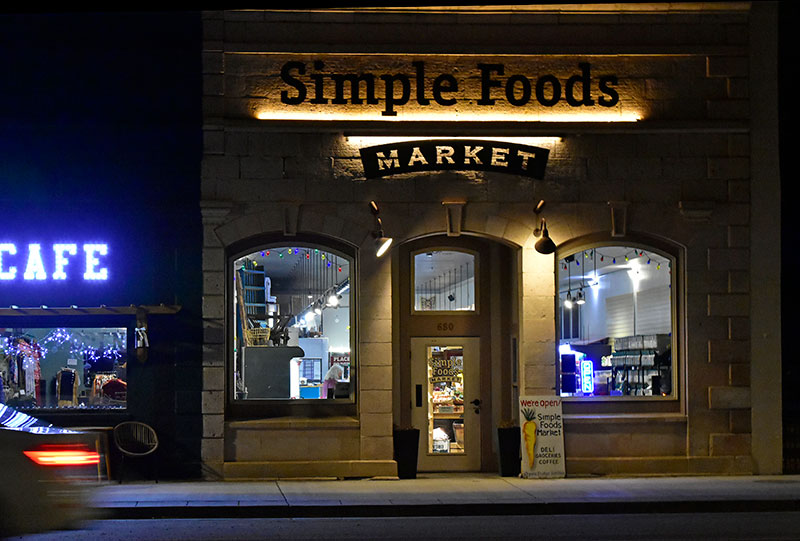
Simple Foods Market’s storefront is shown in the photo above on Friday, Dec. 19, 2025. The store is located at 680 Grand Ave., Del Norte, Colo. Photo by John McEvoy/Special to The Colorado Trust
On a typical grocery store trip, Graham said she spends around $100 for herself, and the roughly $75 weekly stipend from the Food Trust reduces that amount. Not all the items she purchases are covered, but she often carries a balance and has used some of it for food donations.
Graham would love to see programs like this become more common and permanent, especially in her community, where, through her work, she often sees people struggling financially. It could really improve their quality of life, ideally correlating with better mental and physical health outcomes, she said.
“It’s such a simple program, no special cards, no special stuff, just your phone number and go in,” Graham said.
The next phase of the program has a fundraising goal of $1.2 million, according to a Food Trust status report. Officials are still working out the details, but it could include a variety of programming, including an extension of the pilot program, an expansion of “food as medicine” programming—providing people with nutrition-related health conditions access to healthy foods, working with insurers and hospitals—and an exploration of the use of funding from local sugary beverage taxes for similar projects. (The Colorado Trust has provided support for future expansion of the pilot program into Durango and Pueblo.)