Seven men gathered around a table on Christmas morning for a special home-cooked breakfast of egg-cheese-sausage-potato casserole, fresh fruit, homemade sweet rolls and orange juice.
Check-in time at WEShelter, a Grand Junction winter emergency shelter, is usually at 5:30 p.m., with check-out at 8 a.m. However, the site remained open during the day on Christmas, allowing guests to sleep in, enjoy a leisurely breakfast and spend the day indoors. WEShelter (shortened from “winter emergency shelter”) can accommodate up to 16 men seeking a temporary place to stay overnight during the winter months.
As homelessness has continued to increase in Grand Junction, the need for emergency shelter spaces has grown, but the available spots are decreasing. On Feb. 28, HomewardBound of the Grand Valley permanently closed its North Avenue shelter—the largest-capacity shelter in the city, with space for up to 180 guests during the winter—because of unexpected state, federal and private funding cuts, said Brittany Bear, the nonprofit’s board chair. (The shelter had already intermittently closed on weekends in 2025 due to funding shortfalls.)
The temporary WEShelter launched in 2009, when 23 people who were unhoused died during a particularly frigid winter. For 16 years, the shelter took in overflow guests from the North Avenue shelter during the winter months. The Peace and Justice Center, a nonprofit that promotes economic justice (and is based at the Center for Independence), runs this emergency sanctuary.
While WEShelter limits its number of nightly guests, HomewardBound provided shelter to larger groups of people at its two facilities: its now-closed North Avenue shelter, which served adults, veterans and people with pets; and its Pathways Family Shelter, which remains open.
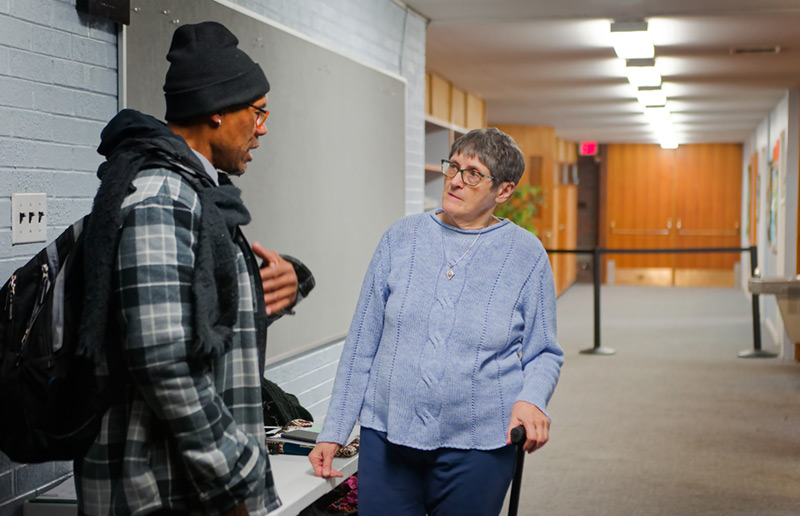
Peace and Justice Center Executive Director Sherry Cole, right, screens Nathaniel Arlington for entry into the temporary WEShelter site on Wednesday, Jan. 14, 2026, at First Christian Church in Grand Junction, Colo. Photo by Barton Glasser / Special to The Colorado Trust
HomewardBound moved more than a dozen adults from the North Avenue facility to the Pathways Family Shelter, which was nearing its capacity of 110. That left about 100 clients from North Avenue without shelter after the closure.
In the winter, the North Avenue shelter would host as many as 180 overnight guests, HomewardBound Chief Operating Officer Chris Masters wrote in an email. Numbers dwindled slightly in warmer months, but “over the past three years, both summer and winter attendance has increased and has consistently remained above 100 clients per night,” Masters said.
Funding has become more challenging: In 2025, HomewardBound had a $1 million budget shortfall, Bear said.
“What we heard is there’s not enough funds to go around—the needs are increasing,” she said. “We’re still facing a budget shortfall even though we’re consolidating those two buildings. We’re still $300,000 short for 2026.”
While WEShelter and other small Grand Junction shelters provide vital services helping people become stable and acquire skills to secure and maintain permanent housing, they are unable to fill the void left by the closure of the city’s main shelter.
City zoning, development and planning regulations limit the number of nightly guests allowed at WEShelter, said Sherry Cole, executive director of the Peace and Justice Center and WEShelter program coordinator. Four local churches and the Center for Independence each take turns hosting WEShelter guests throughout the winter months.
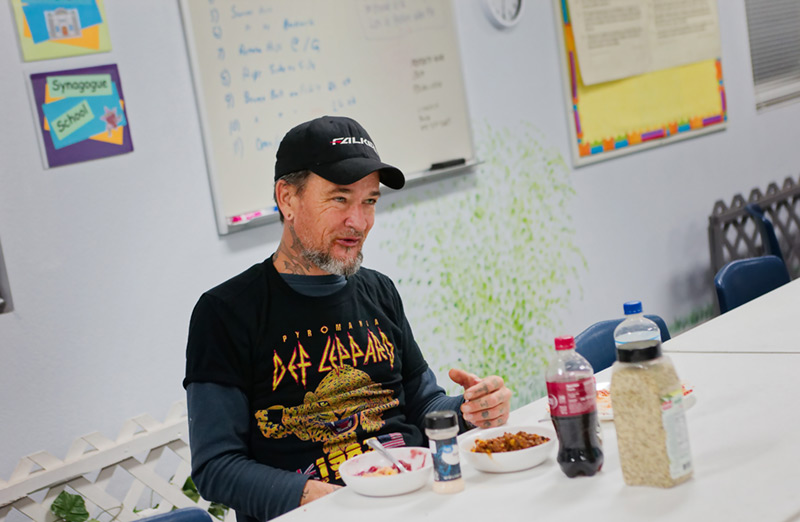
J.J. Springer eats dinner on Wednesday, Jan. 14, 2026, at First Christian Church in Grand Junction, Colo. The church was the temporary site for WEShelter that night. Photo by Barton Glasser / Special to The Colorado Trust
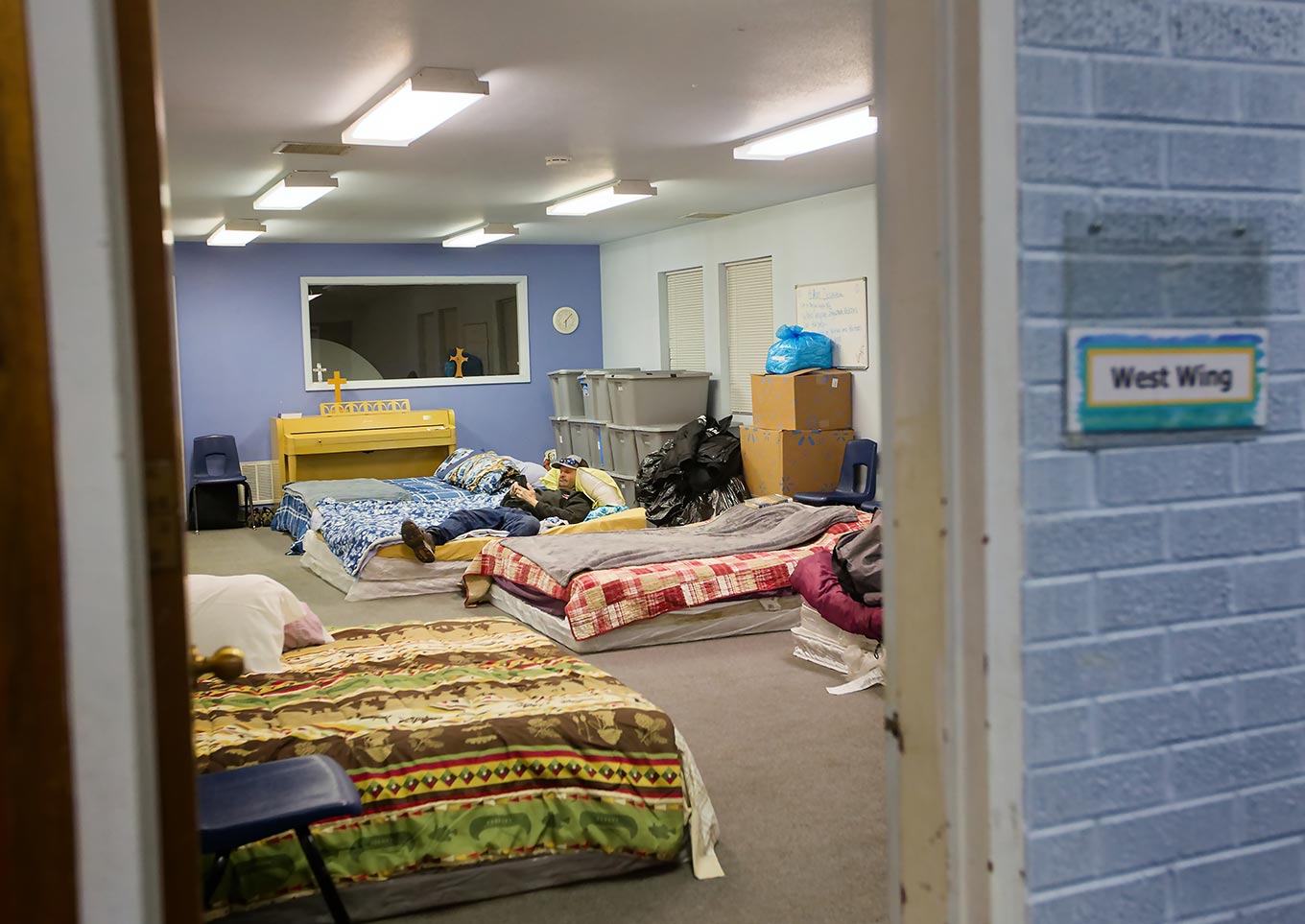
Parishioners and other volunteers provide home-cooked meals, and two volunteers spend the night at the site. Inside the gymnasium-turned-shelter at the Center for Independence, donated mattresses are spread out on the floor, each one neatly made up with clean linens, blankets and new pillows.
Mesa County’s unhoused population was estimated at 725 from a point-in-time count completed on Jan. 28, 2025—an increase of more than 100% since 2019. The count includes both sheltered and unsheltered people experiencing homelessness (sheltered homelessness refers to people staying in temporary or transitional shelters, or another safe haven).
The point-in-time count is a nationwide effort on a single day, so it may significantly underestimate the scope of homelessness. More than 2,400 Mesa County residents are estimated to experience homelessness over the course of a year, according to the Mesa County Collaboration for the Unhoused, a multi-agency initiative working to increase housing stability. The county is believed to have the largest unhoused population on the Western Slope.
Grand Junction City Councilman Scott Beilfuss regularly visits homeless encampments in and around Grand Junction with two city police officers assigned to the Community Resource Unit, which supports unhoused people. In mid-December, Beilfuss and Grand Junction police officers Scott Dearborn and Arnold Naik visited a vacant field off 28 Road after receiving a complaint from the landowner about a trespasser.
A man named John (who declined to provide his last name) was sifting through rubble, looking to salvage items after another unhoused person set fire to his possessions. John said he grew up in Montrose, and he would stay at the North Avenue shelter at night and hang out at the field with his belongings during the day.
“Most everything I own is gone,” he said.
Dearborn and Naik encounter approximately 300 people living in camps around the city throughout the year.
“We want them to be able to reach out to us for help,” said Naik, who’s been with the Community Resource Unit for three years. “We want to help—that’s our primary goal. No one wants to end up homeless. It takes a lot of mental energy and strength to pull themselves up. Or they just don’t know how to get out of it. You have to help one person at a time.”
Cole interviews prospective guests wanting to stay at WEShelter, refers people to resources and ensures they’re willing to abide by strict drug and alcohol bans. She also asks people about any food allergies or special medical needs they might have while staying at WEShelter.
“We want to create a sense of belonging,” she said.
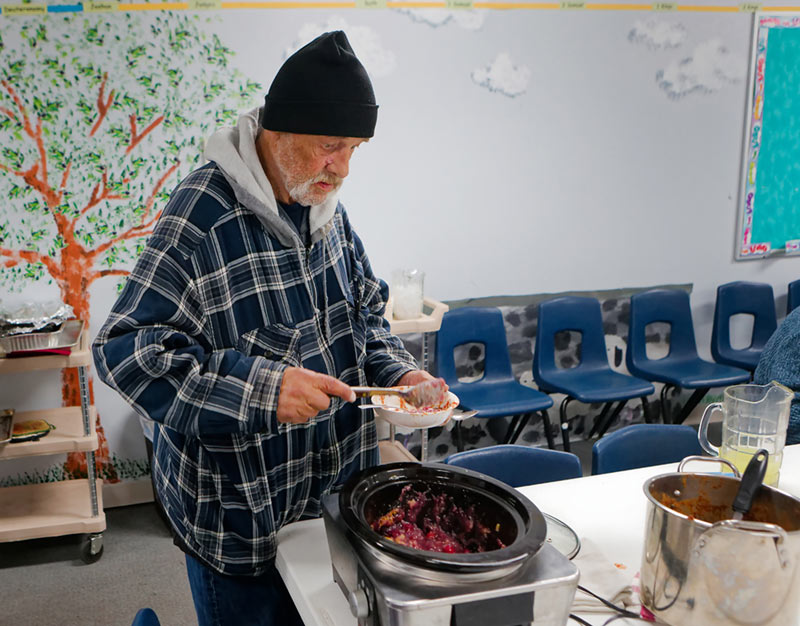
Randy Stewart, who was staying at the temporary WEShelter site on Wednesday, Jan. 14, 2026, serves himself dessert at First Christian Church in Grand Junction, Colo. WEShelter, short for Winter Emergency Shelter, is a program that the Peace and Justice Center runs to provide temporary shelter to men who are unhoused in cold weather. Photo by Barton Glasser / Special to The Colorado Trust
Randy Stewart, 67, began staying at WEShelter this winter after previously spending his nights at the now-closed North Avenue shelter. He’s currently being treated for skin cancer on his face and chest, and he has kidney problems and congenital heart failure.
“I come here [to WEShelter], and I know I’m going to sleep tonight. I’m going to be fed tonight,” Stewart said. “This is a safe place to be. Here, you have all the blankets you need. They want you to be warm. My life has improved dramatically since I’ve been here.”
He had a job, but during a hospital stay, his boss fired him, saying he didn’t want him to “die in his shop,” Stewart said. He said he’s looking for a car and wants to work as a taxi or bus driver. If he can find a job to add to his Social Security payments, he might be able to afford a place to rent.
“I know I can do it. I just need time and help,” he said.
Peter Emmerich was homeless for years before staying at WEShelter three years ago. The 66-year-old said he grew up in an abusive home with parents who rejected him for being gay. He became emotional when talking about the abuse inflicted on him as a child. After suffering a stroke a few years ago, he had to cut back on his landscaping work, could no longer afford rent and began living in his car.
As a WEShelter guest and volunteer, Emmerich met Rev. Paul Ashby, pastor of the First Congregational Church, a WEShelter site. In 2025, after conferring with church board members and securing a letter of recommendation from Cole, Ashby offered Emmerich a place to live in the church’s religious education building and work providing security and landscaping.
“He’s our security person, our night watchman,” Ashby said. “There’s been no vandalism since Peter started staying here. The church has never had better-looking roses. It’s a mutual benefit.”
Emmerich said he saw many men move on from WEShelter last year, to housing, connections and family.
“People started making plans after they got the support they needed,” he said. “It’s all about presence, compassion, paying attention, being open to conversation and not trying to ‘fix’ anyone, but pointing them in the right direction if they want.”
Other local organizations also operate smaller temporary shelters, each with its own programming.
Sunshine Community, a new nonprofit partnership between United Way of Mesa County and Sunshine Rides, offers year-round overnight shelter for eight people. Its first guests, four men and four women, moved into a refurbished Grand Junction building on Jan. 12, said Sunshine Community Executive Director Alex Hitzeroth.
“We call it the Sunshine Community College, where people have to commit to a sober lifestyle and attend individualized programming with us,” Hitzeroth said. There, they learn about budgeting and computers, receive counseling, and acquire other skills for maintaining a home on their own.
Sunshine Community guests can stay anywhere from six months to a year, said Hitzeroth.
There were 28 people on the waiting list in January.
“It’s highly intentional programming,” Hitzeroth said. “A lot of people just need a step up. Sunshine Community is trying to fill the gap.”
Another Grand Junction nonprofit, The Joseph Center, operates two intermediate shelters: Golden Girls for unhoused women age 50 and older, and the new Family Center for families, domestic violence survivors and pregnant women who are unhoused.
There are currently seven women staying in the Golden Girls shelter (which The Colorado Trust profiled in a written story and subsequent video), and six people at the Family Center. Those programs have waiting lists of about 20 people, with wait times up to a year, said Mona Highline, The Joseph Center’s CEO and executive director.
Highline assesses each applicant to ensure they are “ready for the next step,” she said. The program conducts random drug testing.
“We want to get to the root,” Highline said. “We are rebuilding lives. …They learn life skills, they have wraparound services, case management, medical and budget counseling, help with substance abuse and peer support. The need is great.”
Cole of the Peace and Justice Center said some people do better in small-capacity shelters like WEShelter, but the closure of HomewardBound’s North Avenue shelter will mean fewer options for people who need stability and emergency shelter.
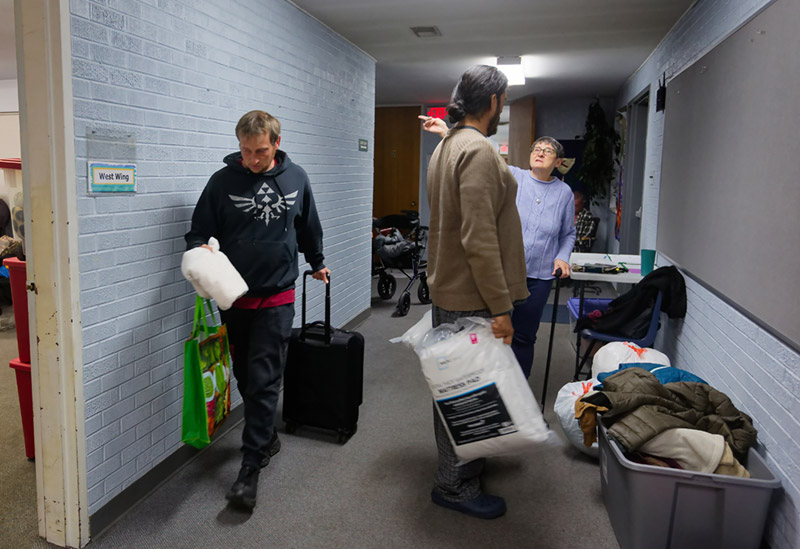
Ben Luksch, left, makes his way to the sleeping area of the temporary WEShelter site on Wednesday, Jan. 14, 2026, as Peace and Justice Center Executive Director Sherry Cole, right, offers donated clothing and blankets to Robert Padron, at First Christian Church in Grand Junction, Colo. Photo by Barton Glasser / Special to The Colorado Trust
“HomewardBound was never supposed to be a long-term shelter,” Cole said. “Some people have stayed there for five years, waiting for housing vouchers.” Some have vouchers but have been unable to find a landlord who will rent to them, she added.
“It’s embarrassing that people wait that long for housing, and then the shelter closes. I find it very sad.”